The German Marine Research Alliance (DAM – German Marine Research Alliance, Deutsche Allianz Meeresforschung) has confirmed the continuation of its “Underway Research Data” initiative, reinforcing the long-term contribution of German research vessels observations to ocean monitoring systems and therefore enhancing the Copernicus Marine Service through the In Situ Thematic Assembly Centre (In Situ TAC).
Through the first two phases of the project “Underway Research Data from German Research Vessels” (2021–2022 and 2023–2025), DAM established harmonised procedures for the quality control of underway (along-track ship) observations and implemented an operational data flow towards the PANGAEA Data Publisher for Earth & Environmental Science. In close collaboration with the Federal Maritime and Hydrographic Agency of Germany (BSH – Bundesamt für Seeschifffahrt und Hydrographie), these datasets are integrated into the Copernicus Marine In Situ TAC and become available through the Copernicus Marine catalogue only a few months after acquisition.
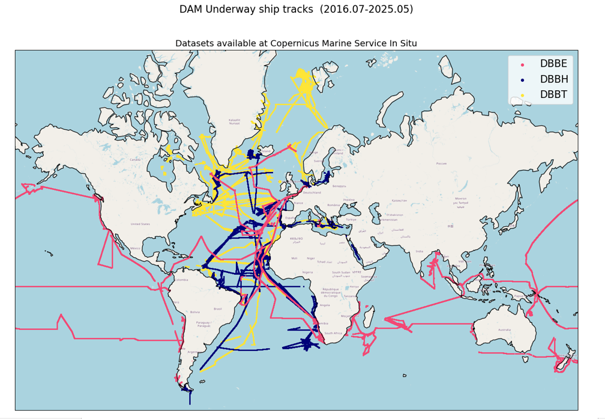
Datasets integrated during the first phases include temperature, salinity, ocean currents and biogeochemical observations collected between 2016 and 2025 from three German research vessels: RV Sonne (DBBE), RV Maria S. Merian (DBBT) and RV Meteor (DBBH). The interface infrastructure has also enabled access to delayed‑mode thermosalinograph data from the research vessels Polarstern (DBLK), Heincke (DBCK) and Alkor (DBND), which were already available in PANGAEA prior to DAM activities.
Originally scheduled to end in autumn 2025, the second phase was extended until February 2026. In parallel, the continuation of the programme was secured with the approval of a third phase which started in March 2026, for a duration of two years. Discussions between partners have also confirmed the intention to further strengthen operational integration and enhance the added value of underway observations within the In Situ TAC framework.
This continuation represents an important step forward for the sustainability of the German programme and in the same way, will strengthen the availability of high-quality observations for the Copernicus Marine Service.